Páginas

Mostrar mensagens com a etiqueta EVENTOS_events_événements_eventi_veranstaltungen. Mostrar todas as mensagens

10 maio 2024

Full Immersion Nella Terra_Sardinia_Italy_2024


Full Immersion Nella Terra 2024

Earthen construction workshop, 22-26 June 2024.Sardinia, Italy.
Online conferences, 11 & 18 June 2024.
Hands-on Workshop
22 - 26 JUNE 2024 PARK OF SANTA MARIA DI SIBIOLA SERDIANA,SARDINIA, ITALY

DICAAR - Dipartimento di Ingegneria Civile, Ambientale e Architettura - Università degli Studi di Cagliari with the UNITWIN UNESCO Chair “Earthen Architecture, Building Cultures and Sustainable Development”, in collaboration with Luca Noli Association and Associazione Internazionale Città della Terra Cruda; supported by the Consiglio Internazionale dei Monumenti e dei Siti - Comitato Nazionale Italiano and the International Scientific Committee on Earthen Architectural Heritage of ICOMOS (ISCEAH), organize 5 days of hands-on workshop, thematic seminars on earth building and a guided tour to local earthen architecture.
The hands-on workshop will be coordinated by professionals trained at CRAterre and will take place at the Park of Santa Maria di Sibiola (Sardinia, Italy).
Participants will learn to employ soil as material for construction and the different earth building techniques.

04 maio 2024

Exhibition “Down to Earth: Indigenous Building Technologies”_Pratt University USA


Exhibition “Down to Earth: Indigenous Building Technologies”
April 30 – May 7, 20247:00 PM – 5:00 PM
Higgins Hall, Leo J. Kuhn Lobby Gallery
Gallery opens April 30th at 7pm. Join us for a very special exhibition in the lobby of Higgins Hall from May 1st-7th! “Down to Earth: Indigenous Building Technologies” will feature the work of Historic Preservation and other GCPE students who participated in a course taught by Visiting Assistant Professor Debora Barros called “Indigenous Building Technologies as Climate Solutions” which traveled to Brazil during spring break. 
Students participated with community members in a five-day hands-on workshop on earthen vernacular building techniques at TIBÁ Institute, a foremost center in bio-architecture nestled in Brazil’s Atlantic Forest. 
The multi-media exhibition displays their work making adobe bricks, wattle and daub, hyperadobe, geopaints, earthen plasters, tadelakt, and rammed earth, and engaging ed with the local community to build two hyperadobe benches at the soccer field of Barra de Santa Teresa, RJ.

08 maio 2023

Seminário Internacional: Que futuro para a Arquitetura Vernácula e Arquitetura de Terra?_Porto_15-16 Junho 2023_ VERSUS+ | Heritage for People


Seminário Internacional: Que futuro para a Arquitetura Vernácula e Arquitetura de Terra?
a realizar no Porto nos dias 15 e 16 de Junho de 2023, no âmbito do projecto VERSUS+ | Heritage for People
Nos últimos anos, a arquitetura vernácula e a arquitetura de terra têm enfrentado múltiplos desafios em todo o mundo, os quais ameaçam sua sobrevivência.
Em várias regiões, o conhecimento intangível está a desaparecer rapidamente, em parte devido ao facto de haver menos pessoas a manterem viva a cultura construtiva e seu know-how.
Para discutir o futuro da arquitetura vernácula e da arquitetura de terra, convidamos profissionais e investigadores interessados, a reunirem-se no Porto, nos dias 15 e 16 de junho de 2023.
O evento será estruturado em três sessões com debates e uma mesa-redonda. O Seminário Internacional de Arquitetura Vernácula e Arquitetura de Terra será dedicado à documentação vernácula, ao Património Mundial, ao conhecimento intangível, à transferência de conhecimento, à ação climática, à adaptação; e uma mesa redonda final, com contribuições das participantes. O objetivo principal da mesa-redonda será definir caminhos a seguir, para manter viva a arquitetura vernácula e a arquitetura de terra.
Uma publicação, com os artigos dos palestrantes e as notas da mesa-redonda, será publicada em 2023.

Seminário Internacional & Mesa Redonda sobre:
Que futuro para a arquitetura vernácula e a arquitetura de terra?
Sessão 1: Preservar o Passado
Documentação vernácula e Património Mundial
Sessão 2: Valorizar o Presente
Conhecimento intangível e transferência de conhecimento
Sessão 3: Preparar-se para o Futuro
Ação climática e adaptação
Mesa-Redonda: Que futuro para a arquitetura vernácula e a arquitetura de terra?
Organização:
DAMG-UPT | Departamento de Arquitetura & Multimedia Gallaecia da Universidade Portucalense.
CIAUD-UPT | Pólo do Centro de Investigação em Arquitetura, Urbanismo & Design, na Universidade Portucalense.
ICOMOS-Portugal
Enquadramento:
VERSUS+ | Património para as pessoas
Cátedra UNESCO em arquitetura de terra, culturas construtivas, & desenvolvimento sustentável.
Parceria:
UPV, Spain; UNIFI, Italy; UNICA, Italy; CRAterre-ENSAG, France.
Informação importante:
- Os interessados devem enviar email para: ciaud-upt@upt.pt (até: 15 de maio).
- O e-mail deve incluir: título da sessão; título do artigo; autores; afiliação (instituição e país) e resumo curto (máx. 200 palavras).
- Os organizadores responderão: nos três dias seguintes, a informar sobre a aceitação (ou não) do resumo.
- Se o resumo for aceite: os palestrantes apresentarão a sua comunicação, no Porto, nos dias 15 e 16 de junho.
- Os palestrantes devem enviar: um artigo de 4 a 6 páginas até 7 de julho de 2023. Mais instruções serão enviadas após a aceitação do resumo. O artigo será publicado após o Seminário Internacional.
- Idioma da comunicação e artigo: inglês.
Vários especialistas já confirmaram a sua participação, pelo que todos os potencias palestrantes, interessados em participar, deverão enviar um resumo, o mais breve possível.

in English
On the last years, vernacular architecture and earthen architecture have faced multiple challenges worldwide, which have threaten their survival. In several regions, intangible knowledge is disappearing fast, in part due to the fact there is less people keeping the building culture and its know-how alive.
To discuss the future of vernacular architecture and earthen architecture, we are inviting interested professionals and researchers to meet in Porto, on June 15 & 16, 2023.
The event will be structured in three sessions with debates and a round-table. The International Seminar on Vernacular and Earthen Architecture will be dedicated to vernacular documentation, World Heritage, intangible knowledge, knowledge transfer, climate action, adaptation, and a final round-table discussion with input from participations. The key-purpose of the round-table will be to establish ways forward, on how to keep vernacular and earthen architecture alive.
A publication with the paper’s proceedings, and the round-table notes, will be published in 2023.

International Seminar & Round-Table on:
Which future for vernacular architecture & earthen architecture?
Session 1: Preserving the Past
Vernacular documentation & World Heritage
Session 2: Valuing the Present
Intangible knowledge & knowledge transfer
Session 3: Preparing for the Future
Climate action & adaptation
Round-Table: Which future for vernacular architecture & earthen architecture?
Organisation:
DAMG-UPT | Department of Architecture & Multimedia Gallaecia at Portucalense University
CIAUD-UPT | Research Centre in Architecture, Urbanism & Design at Portucalense University
ICOMOS-Portugal
Framework:
VERSUS+ | Heritage for People
UNESCO Chair on earthen architecture, building cultures, & sustainable development.
Partnership:
UPV, Spain; UNIFI, Italy; UNICA, Italy; CRAterre-ENSAG, France.
Important information:
- Interested speakers should send an email to: ciaud-upt@upt.pt (no later than: May 15).
- The email should include: session title; paper title; authors; affiliation (institution, & country), and short abstract (max. 200 words).
- Organisers will respond: in the following three days, informing about the acceptance (or not) of the abstract.
- If the abstract is accepted: speakers will present their communication in Porto, on June 15 & 16.
- Speakers should submit: A 4 to 6 page paper should be send by July 7, 2023. Further instructions will be sent, following the acceptance of the abstract. The paper will be published in the Seminar proceedings following the event.
- Paper presentation and publication: Will be in English.
Several experts already confirmed their participation, so all the interested speakers should send an abstract, as soon as possible.

20 outubro 2022

Jornada Técnica_OET|SRSUL_28 Out2022_Odemira

No próximo dia 28 de outubro, a Secção Regional do Sul da Ordem dos Engenheiros Técnicos vai promover a realização, em Odemira, de uma Jornada Técnica, que decorrerá no Cineteatro Camacho Costa entre as 09h00 e as 17h30, onde se abordarão os seguintes temas:

1. Construção em Taipa: Projeto;

2. Construção em Taipa: Execução;

3. Coordenação de Segurança em Obra e Licenciamento;

4. Reforço Sísmico.

A participação é gratuita, mas sujeita a inscrição. Brevemente será disponibilizado o programa definitivo.
A inscrição deverá ser formalizada através do endereço de e-mail srsul@oet.pt, indicando os seguintes dados:
- Nome completo, nº de membro (se for o caso), contato telefónico e e-mail

29 março 2022

Webinar_Alternative Building Methods

Alternative Building Methods Webinar
Ever wanted to learn about sustainable building techniques such as rammed earth and straw bale? This webinar will provide information about the processes involved and some inspiration for your own sustainable build. 
Straw Bale Building with Lance Kairl, House of Bales. Licensed builder and building works supervisor, South Australia’s most experienced and respected strawbale builder. 
Rammed Earth Building with Stephen Dobson B.Eng., B. Comm., MIEAUST ( Ret'd ), Reg'd Builder WA 3982 ( Ret'd), EBAA Committee Member (Life Member), Director, Ramtec Pty Ltd. Proudly presented by Gawler Environment Centre with support from Northern and Yorke Landscape Board.

15 março 2022

Webinaire_Construire en terre en commande publique : l'École des collines_Valherbasse


11 février 2022_Webinaire_Construire en terre en commande publique_Ecole des collines de Valherbasse en pisé (Design & architecture et Nama architecture)
Dans le cadre du cycle de webinaires organisé par Les Grands Ateliers et EnvirobatBDM, ce deuxième webinaire permet de découvrir la technique du pisé, au travers de l'exemple du groupe scolaire intercommunale des collines à Valherbasse dans la Drôme.
Les intervenants sont : Nadine Chevrol (Présidente du SIVOS de la haute Herbasse, maître d’ouvrage du projet), Milena Stefanova (architecte au sein de Design et Architecture) et Jean-Marie Letiec (architecte au sein de NAMA Architecture)

14 março 2022

Webinar_Natural Materials Masterclass: Building with Earth_ACAN

 
Webinar_Natural Materials Masterclass: Building with Earth
7th October 2021
This webinar talks about clay plasters, earth blocks, rammed earth and chalk, cob, and most importantly, how we can use these materials in our building projects. 
In the webinar, we hear from expert speakers: 
Rowland Keable - EBUKI & Rammed Earth Consulting 
A founding member of EBUKI, Rowland works towards earth in the mainstream of construction. This includes being an active member of a European skills group working on training standards for earth structures. He has worked with rammed earth technology since 1985 including Passivhaus local authority classrooms, and he has written earth construction codes and standards in the UK, Europe and Africa. 
Becky Little - EBUKI & Rebearth 
Becky is an earth builder and artist with 30 years experience in heritage and new build. Her company Rebearth specialises in education and research using earth and fibre and she is a project officer for EBUKI currently working on training for social impact. 
Tom Morton - Arc Architects 
Tom leads Arc Architects whose work on eco-building, heritage and research has a generative approach to the confluence of the built and natural environments. Tom also works with the charities Earth Building UK & Ireland and Cohousing Scotland. He is currently collaborating with Ghanaian-Filipino agro-waste designer Mae-ling Lokko and Glasgow School of Art on the Future by Design project for COP26 in Glasgow. 
Paul Mallion - Conker Conservation 
Paul is a chartered building surveyor and certified Passivhaus designer, director of Conker Conservation Ltd of Canterbury, set up in 1999 to focus on sustainable design in new build, retrofit and historic buildings. 
Clare Whitney - Clayworks 
Clayworks is the world’s leading manufacturer and supplier of 100% natural clay plasters. Based in Cornwall, the company was originally a cob building company and has focused on researching and developing natural interior wall finishes that are highly contemporary, consistent in high quality and easily accessible to everybody, anywhere in the world. Clare Whitney has worked with the company for 15 years.
Organized by Architects Climate Action Network (ACAN). For more information about ACAN and to join their mailing list please visit: https://www.architectscan.org/home

Exemplo_Baan Doi_Thailand


Exemplo_Baan Doi_Thailand
Students from Linz are currently finalising the administration unit of BASEhabitat permaculture project in northern Thailand.
In October 2022, new Postgraduate students will develop and build a prototype for guest houses on site.
Interested in joining their Postgraduate Program? There are still some last places available! More info on www.basehabitat.org/study/postgrad/
Photos (c) Paul Eis

10 março 2022

Laetitia Fontaine_CRATerre-ENSAG

Laetitia Fontaine
Ingénieure matériaux, Laboratoire CRAterre – AE&CC – ENSA Grenoble 
Directrice du Centre de Recherche et d’expérimentation AMÀCO (atelier matières à construire) Laetitia Fontaine est spécialisée dans les matériaux de construction. Elle poursuit depuis 2004 au laboratoire CRATerre-ENSAG des activités d’enseignement et de recherche, notamment l’étude des relations entre microstructure et propriétés macroscopiques du matériau terre. Elle est co-responsable de l’un des 3 thèmes de recherche, nommé Matière / Matériaux, du programme scientifique du laboratoire CRAterre. Laetitia Fontaine s’est vue attribuer le Prix Pour les femmes et la science de la Fondation L’Oréal – UNESCO – Académie des Sciences, pour son travail en recherche doctorale. 
Elle est co-auteur de l’exposition Ma terre première, pour construire demain présentée à la Cité des sciences et de l’industrie à Paris et du livre Bâtir en terre, du grain de sable à l’architecture.
Terre, matière à construire
Science, technique, art et architecture
La terre est une énigme. Ce matériau si commun mais pourtant si étrange est constitué de grains (cailloux, graviers, sables, silts et argiles), d’eau et d’air qui forment un sol avec une histoire géologique. A partir de ces trois éléments, on obtient un matériau solide qui permet de construire un mur, une structure, un édifice.
C’est ainsi que l’on passe du grain à l’architecture. Tous ces grains tiennent ensemble comme par magie. Pour comprendre pourquoi ils tiennent ensemble, il faut réapprendre ce qu’est un sable ou une poudre, un liquide et un gaz. Porter un regard neuf sur la matière. Et en particulier sur toutes ces choses communes que l’on croyait connaître.
De tous les éco-matériaux, la terre est celui qui possède la charge symbolique la plus forte. Elle invite à la magie, à l’émotion et à la créativité. c’est une ressource universelle qui génère une prodigieuse diversité d’architectures vernaculaires et contemporaines. Ces matières premières inspirent un nouveau rapport au monde, où les habitants construisent à partir de ce qu’ils ont sous les pieds et à portée de main.

22 fevereiro 2022

Workshop de Construção em Taipa_Aljezur_23-26 de Abril 2022

WORKSHOP de CONSTRUÇÃO EM TAIPA - Aljezur - Dias 23, 24, 25 e 26 de Abril 2022
Formação teórico-prática, inserida num contexto de intervenção pontual numa ruína em Aljezur, em pleno Parque Natural do Sudoeste Alentejano e Costa Vicentina (com alojamento na Pousada de Juventude da Arrifana).
Fique a saber mais sobre a construção em taipa, construindo e aprofundando entre taipais os conceitos de reconstrução e reabilitação destas estruturas.
Venha conhecer as ferramentas associadas a este material intemporal e uma tecnologia tradicional e ecológica!
Participe! 
Aqui pode aceder ao Programa e à Ficha de Inscrição.
Mais informação sobre esta formação em http://www.arqcoop.com/construcao-em-taipa/

Webinar_Future Now Pavilion - Webinar: Earth, Clay & Context

Future Now Pavilion - Webinar: Earth, Clay & Context_29th September 2021
Webinar jointly organized by Swissnex in Brazil and Insight Architecture. It is a discussion on the use of earth and clay in modern architecture, showing the shift from spectacular to vernacular architecture.
This debate is part of the complementary activities of the UIA2021RIO and intends to stress this discussion further, through the dialogue between prominent international architects, whose work is deeply connected with earthen architecture and biological materials.
Different civilizations in different parts of the world have been building with earth and clay for many centuries. Modern life and the current globalized world, though, have taken this material to a peripheral role in our cities. Its properties of climate and humidity regulation, its connection with the place where we build and its cultural traditions have been basically vanished through the appearance of other construction techniques and cheap energy in the 20th century. But this story seems to have an inflection point. The 27th World Congress of Architects UIA2021RIO brought strong voices advocating for a different kind of architecture – a shift from spectacular architecture to vernacular architecture.
Martin Rauch and Fernando Minto share their experience working primarily with earth and earth-based materials in such different contexts as Brazil and Europe.
Over the past 10 years, Martin Rauch has been intensively involved in the mechanical prefabrication of rammed earth building components. For this purpose, a worldwide unique process was developed to produce prefabricated rammed earth components in high homogeneous quality. This process has already been used in several large-scale projects on site and with local raw materials. The experience gained in these large-scale projects was integrated into the ERDEN factory workshop at the new production site in Schlins (Austria) by means of a production infrastructure customised for rammed earth construction. The ERDEN Werkhalle is a pioneering production facility for the industrial manufacture of rammed earth building elements.
The architecture and construction with earth in Brazil has been the object of increased interest. Gradually, research centers and private companies invest more resources for its repositioning in the current scenario compared to more conventional techniques. In this webinar, Fernando Minto will discuss the specificities of this modality in Brazil and the main characteristics that surround it in its territory, both in environmental and climatic aspects as well as in social aspects, including the current insertion in the construction market.
To explore these topics, Insight Architecture and Swissnex Brazil invited Martin Rauch (Austria), founder of Lehm Ton Erde Baukunst and Fernando Minto (Brazil), professor at the Federal University of Rio de Janeiro UFRJ to this webinar. They present their work and discuss the challenges and opportunities they see in earthen architecture for the future of our cities. Igor de Vetyemy, architect and president of the Brazilian Institute of Architects in Rio de Janeiro IAB moderates the conversation. The event was held in English and Portuguese, with simultaneous translation to both languages. The webinar was part of the Insight Architecture’s Future Now event, which investigates the use of sustainable materials and new construction techniques such as digital fabrication in architecture as part of the 27th World Congress of Architects UIA 2021 Rio calendar.

Participants
Martin Rauch was born in Schlins, Vorarlberg, Austria and graduated from the University of Applied Arts, Vienna. During three decades of research in theory and practice, Martin Rauch succeeded in updating traditional rammed earth techniques and integrating them into contemporary architecture, both in terms of design and technology. 1999 Foundation of the company Lehm Ton Erde Baukunst in Schlins; with this company he realized numerous international projects. He was awarded by the 2008 International Prize for Sustainable Architecture Fassa Bortolo Italy, 2008 Building Award of the Central Association of Austrian Architects, 2011 Holcim Award - Morocco and New European Bauhaus Prize 2021. 2003 to 2010 teaching at the Linz University of Art. International workshops in Bangladesh, South Africa and Austria in cooperation with BASEhabitat. Since 2010 honorary professor of the UNESCO chair Earthen architecture, building cultures and sustainable development. Since 2014 guest lecturer at the Swiss Federal Institute of Technology ETH Zurich.
Fernando Minto is an urbanist, architect and adjunct professor of the Department of Architecture and Urbanism FAU at the Federal University of Rio de Janeiro UFRJ. Minto obtains a master (FAU USP) and doctor (FAU UFRJ) in technology of architecture; he coordinates the architecture office Matéria Base in Rio de Janeiro and is an associate of Terrabrasil and of the Ibero-American network Proterra. He graduated from UNIMEP - UNESCO chair in earth construction in 1998, working with earth constructions since then. He was a founding member of ABCterra (1997), participated in the ABCTerra pavilions at the 3rd and 4th International Biennale of Architecture BIA in São Paulo and has worked on several projects with rammed earth.
Moderation: Igor de Vetyemy The Brazilian architect and professor Igor de Vetyemy is the general commissioner of the 27th World Congress of Architects UIA2021RIO and the current president of the Brazilian Institute of Architects IAB in Rio de Janeiro, ahead of a collective mandate called Oxigena IAB. Teacher and researcher in Universidade Veiga de Almeida, Universidade Estacio de Sá, and Istituto Europeo di Design, de Vetyemy works with earth architecture connecting students and indigene tribes in the state of Rio de Janeiro. He has been director of the Brazilian Institute of Architecture Education - ABEA. Author of Mutualistic Architecture, Compilation of projects reflections and buildings of Marcos Konder Netto, and Powers of ten – 100 exponents of Rio de Janeiro contemporary architecture, Igor de Vetyemy has also produced and directed the movie Konder – the magnificence of simplicity.
Click on the timecodes below to be redirected to their point in the recording: 
[0:00] Intro Event & Insight Architecture; 
[08:50] Intro Swissnex in Brazil; 
[10:10] Igor de Vetyemy - Moderator; 
[13:12] Martin Rauch; 
[39:31] Fernando Minto; 
[58:10] Q & A with the participants;
Watch the full livestream here

12 outubro 2021

SAT21_Seminário Arquitetura em Terra_"Terra material regenerativo”_6 e 7_Novembro_2021.


A associação Centro da Terra (CdT) está a organizar o evento SAT21 - Seminário Arquitetura em Terra – "Terra material regenerativo”.
O seminário terá lugar na Biblioteca Municipal Manuel da Fonseca, Santiago do Cacém nos dias 6 e 7 de Novembro de 2021.

A utilização de elementos construtivos em terra pode resultar na redução dos potenciais impactes ambientais em cerca de 50%, quando comparados com o uso de materiais convencionais.
Este Seminário, será assim um momento de partilha, sensibilização e disseminação de conhecimentos e o debate interdisciplinar sobre os temas e desafios que envolvem este tipo de construção.
O evento é destinado a todos os profissionais da área da construção e ao público em geral.
No primeiro dia, 6 de Novembro, será o desenvolvimento do Seminário, terminando o dia com uma Mesa Redonda.
No Segundo dia, 7 de Novembro, decorrerá uma visita com foco na Arquitectura em Terra, da região de Santiago do Cacém, durante todo o dia.
Haverá ainda uma Exposição dedicada ao tema do Seminário, a decorrer paralelamente ao mesmo.
A Mesa Redonda e Exposição irão abordar, entre outras, a questão da gestão da terra na indústria da construção e como valorizar esta matéria prima para facilitar a sua implementação na indústria da construção e garantir a qualidade dos edifícios.

Para inscrição preencha o formulário https://forms.gle/9CXuvQrJTndMgQb78

Para mais informações acedam à Pagina web SAT21, pelo FaceBook evento SAT21 ou entrando em contacto para info.centrodaterra@gmail.com

A CdT agradece desde já o apoio de todos na divulgação deste importante evento. 
Partilhem e participem!

13 agosto 2021

Exhibition 'Asaase'_David Adjaye_New York

Asaase
Text by John Hill for www.world-architects.com/en/architecture-news/ (30. June 2021)

© Photo John Hill / World-Architects
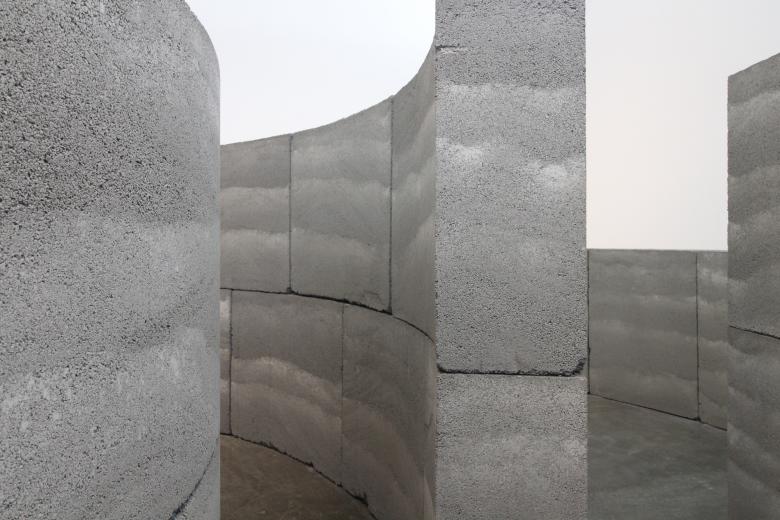
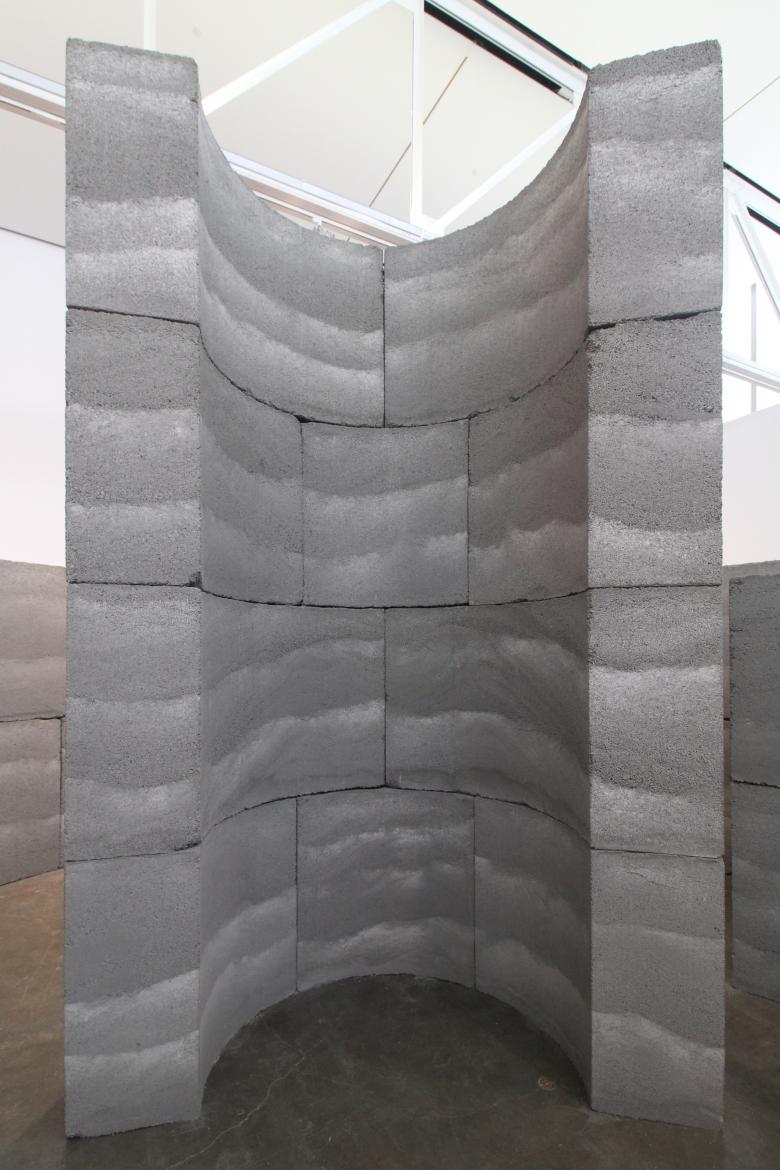
'David Adjaye's Asaase, billed as the architect's first "large scale autonomous sculpture," is on display at Gagosian Gallery in New York as part of Social Works, a group exhibition curated by Antwaun Sargent that "considers the relationship between space — personal, public, institutional, and psychic — and Black social practice."
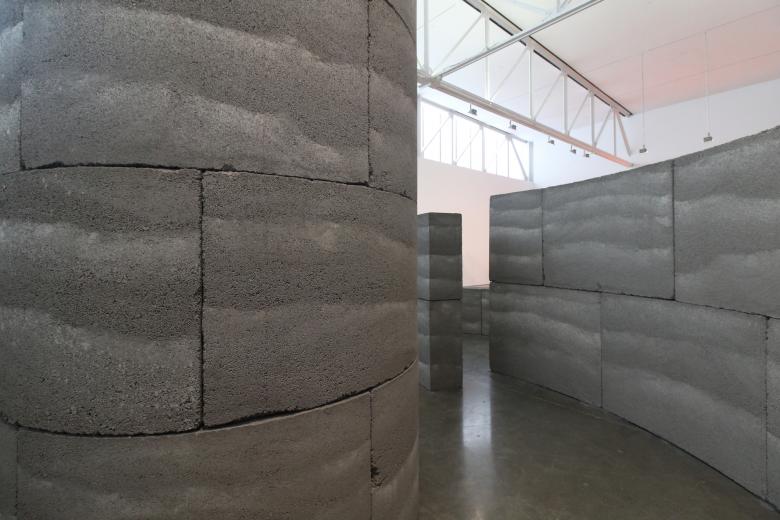
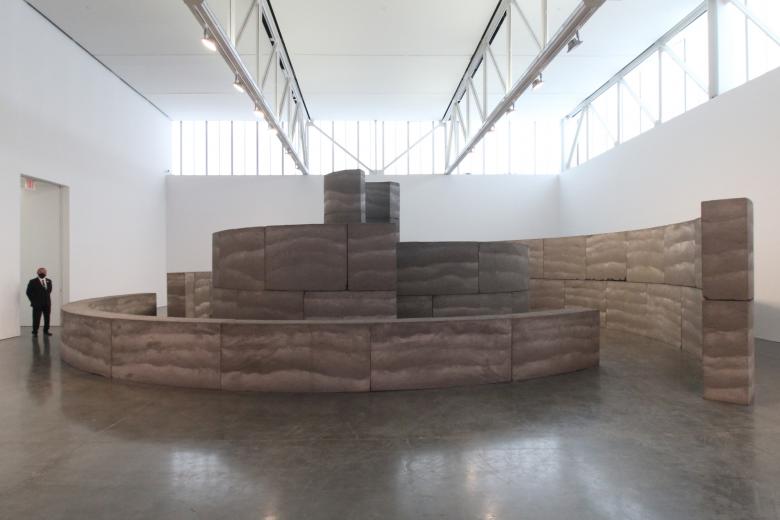
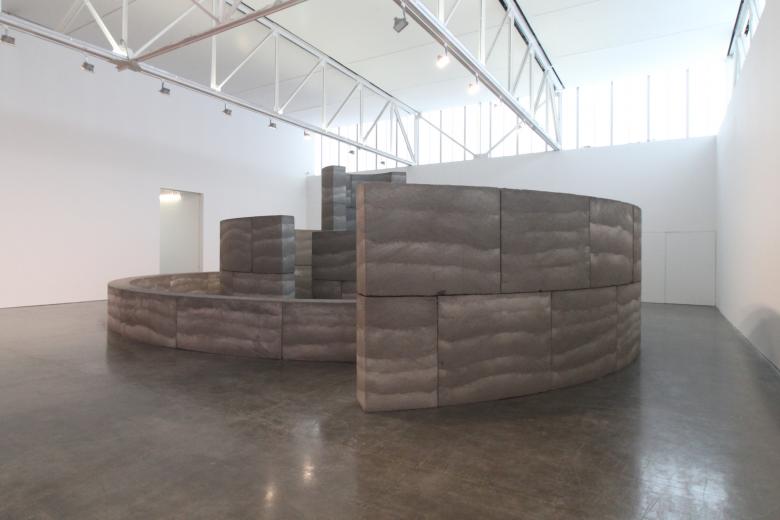
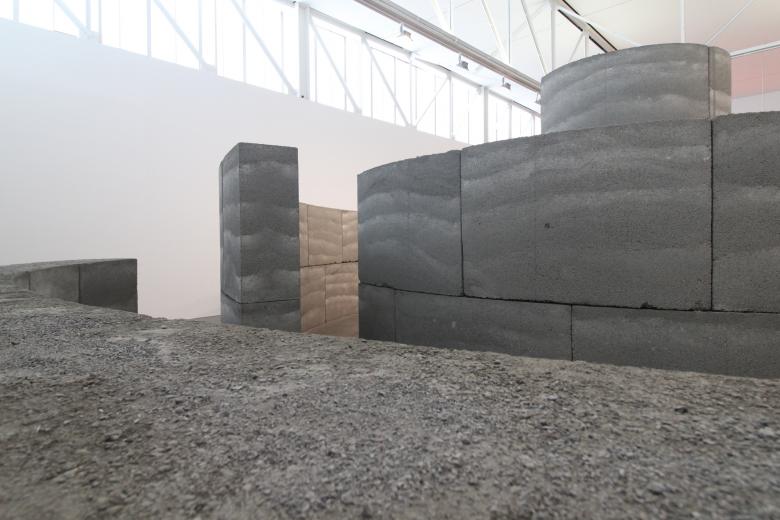
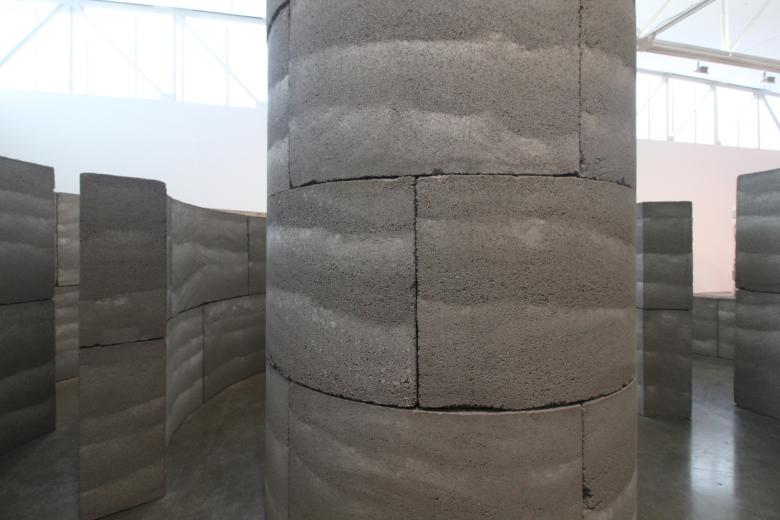
Asaase is a maze-like sculpture of walls made from rammed earth, the stacked blocks increasing in height toward a "conical vertex" in the center. Adjaye notes a couple West African references for the installation on his website: the Tiébélé royal complex in Burkina Faso, which is confined by earthen walls painted with patterns, and the walled city of Agadez in Niger, with its famous 27-meter-high mud-brick minaret. With these references, Asaase captures the architect's "ongoing reflections on the origins of black architecture and its relationship to the earth."
Below is a quick tour of Asaase, which is on display at Gagosian Gallery (555 West 24th Street) as part of Social Works from June 24 to August 13, 2021.
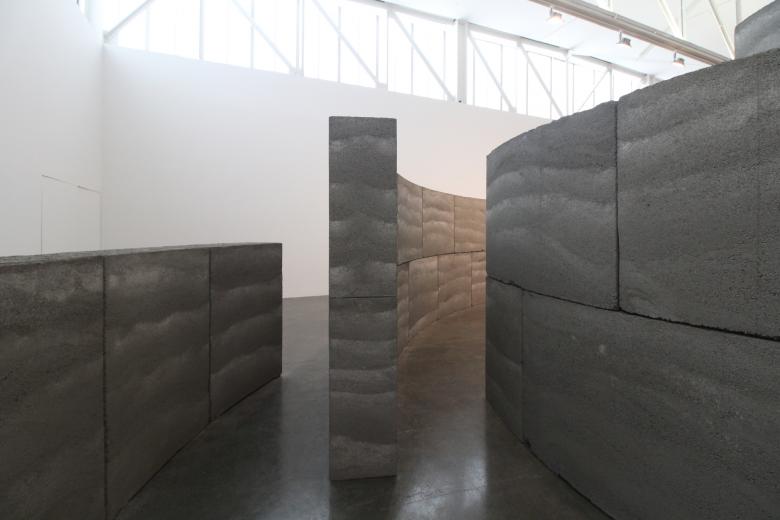
The maze-like sculpture sits at one end of a large gallery where soft light pours in through south- and west-facing clerestory windows.
The concentric curved walls invite visitors to explore the interstitial spaces between the gallery walls and the piece before entering the spaces inside Asaase.'


© Photos John Hill / World-Architects
'The overlapping walls mean there are numerous ways to encounter the installation and move through its spaces.
The rammed earth blocks are made from crushed limestone and schist from New York, with the tops of the shorter walls at the perimeter revealing some of the loose aggregate that went into their making.
In a recent conversation at Gagosian Gallery, embedded below, Adjaye describes Asaase as "a reflection of the past two years — really it's about my career, my entire life."
The pause of the last two years led Adjaye to be introspective — and create an expression of it, with the installation's earthen walls leading to an intimate interior.
Adjaye describes Asaase as a meditation "on the notions of fragments" made up of "fragments of chambers," none more overt than the niche-like conical vortex at the center of the maze.'

09 junho 2021

Exposition PISÉ – Tradition et potentiel

En dépit de sa disponibilité et de sa durabilité la terre comme matériau de construction reste encore méconnue et n’est pas vraiment ancrée dans notre culture, alors qu’elle possède une tradition sous nos latitudes. Cette exposition veut rappeler l’histoire européenne du matériau terre, notamment la construction en pisé en France et son influence sur la Suisse.
En Europe, la technique du pisé est apparue il y a plus de 2000 ans. Hannibal l’aurait déjà utilisée pour des fortifications au cours de ses campagnes militaires. Dans la région Rhône-Alpes, les constructions en pisé connurent dès le milieu du 16e siècle un premier essor avec la croissance rapide des villes. Un deuxième suivit au 19e siècle avec l’exode rural et la pénurie de logement qu’il entraîna. Le savoir lié à la construction en terre a été transmis de la France à la Suisse grâce au commerce du lin. En Suisse orientale, différentes constructions en pisé apparurent à partir du 17e siècle.
Cette exposition permet d’en savoir plus sur le matériau terre pour le rendre accessible et perceptible à la fois par ses propriétés et par sa présence physique. Elle montre ses composants et son traitement, suit l’avancement des constructions en pisé actuelles et ose un regard sur l’avenir. Elle se penche tout particulièrement sur la possibilité d’une préfabrication industrielle qui permettrait d’ouvrir de nouvelles perspectives d’un point de vue constructif et architectural. Avec la Maison des Herbes de Ricola de Herzog & de Meuron récemment construite, le pionnier du pisé Martin Rauch a démontré le potentiel que recèle la préfabrication pour l’adaptation à de nouvelles dimensions et proportions. D’autres projets de cette échelle vont suivre, comme l’Océanium à Bâle. 
À l’EPFL, nous avons étudié la faisabilité des constructions hybrides en terre et optimisé leurs avantages constructifs et énergétiques. Au coeur du projet de l’atelier Boltshauser se trouvaient des questions stimulantes concernant la structure ainsi qu’un besoin de défricher des nouveaux chemins pour une expression architecturale en terre.
Une exposition produite par ARCHIZOOM
Vues de l’exposition
Construction d'un mur en pisé avec les étudiants de l'EPFL, sous la direction de Timur Ersen, pour l'exposition "Pisé. Tradition et Potentiel"

COMMISSAIRES
Roger Boltshauser
Marlène Witry
COLLABORATEURS
Janina Flückiger (conception pisé Suisse)
Clemens Quirin, Lehm Ton Erde (conception domaine matériaux)
ENTREPRISES PARTENAIRES
Erne Holzbau AG (coffrages en bois)
Martin Rauch, Lehm Ton Erde (matériaux et tableau en terre crue)
Timur Ersen (murs en terre crue)
DESIGN GRAPHIQUE
Büro 146. Maike Hamacher, Valentin Hindermann, Madeleine Stahel, Zurich
Mit Tiziana Artemisio
PHOTOGRAPHIE
Philip Heckhausen (photographie pisé Suisse, pisé France)
Noémie Allenbach Tsu-Shin (photographie travaux d’étudiants)
Sébastien Friess (photographie travaux d’étudiants)
RÉVISION TECHNIQUE
Laura Marcheggiano (FR/EN)

25 junho 2020

Cátedra UNESCO de Arquitectura de tierra, culturas constructivas y desarrollo sostenible_Junho 2020


La Cátedra UNESCO de Arquitectura de tierra, culturas constructivas y desarrollo sostenible (por Fernando Vegas y Camilla Mileto) continuara con las conferencias programadas a pesar de las circunstancias actuales. Durante la actual situación de emergencia sanitaria mundial, las conferencias seguirán siendo realizadas telemáticamente y publicadas en su canal de Youtube.

El título de la próxima conferencia es "La construcción de la arquitectura del vino en la comarca Utiel-Requena: el caso de Cuadete de las Fuentes" y correrá a cargo de Raquel Giménez Ibáñez. Ya está disponible en el canal de Youtube, puedes verla aquí.

Grupo de Investigación
Res-Arquitectura - Investigación, Restauración y Difusión del Patrimonio Arquitectónico
Universitat Politècnica de València
Camino de Vera s/n, 46022 - Valencia - Spain 
Building 8B, Access L, Floor 0
Ph: +34 963877971
Open Access Journal "Loggia - Arquitectura & Restauración"

23 março 2015

15º SIACOT_Equador_Novembro 2015

15º SIACOT
Seminario Iberoamericano de Arquitectura Y Construcción con Tierra.
9-13 Nov. 2015
Cuenca, Equador

Earth Building UK_June 2015

Earth Building UK event for June 2015.
The event is substantially enlarged from previous years and include a week long schedule of workshops, culminating in the EBUK conference. 
You can also find LOTS more information on the EBUK website:
Please find information on week-long festival of earth building to be held in Scotland in June. The events include practical workshops, a conference, building tours, as well as other events, all vested in a small community setting.
More information can be found at http://www.ebuk.uk.com/ebuk-2015-clayfest/
Of particular interest to you may be a symposium of turf building where we are keen to find a wide range of contributors on archaeology, ethnography, reconstruction, training and new build. We are inviting proposals for short presentations to the symposium, which should have an interesting and engaged audience.

Forward this information to anyone you know who may also be interested!

30 setembro 2014

Workshops EMBARRO_2014

Workshops Embarro/Casa da Cor em São Brás de Alportel.
Dias 10 e 11 de Outubro - Aplicação de Tadelakt
Dias 17 e 18 de Outubro - Aplicação de Rebocos de Barro.

Para mais informação contactem a Embarro
Tel. +351 289.845.032 Tmvl. +351 918.888.222 mail info@embarro.com
ou visitem o website www.embarro.com


10 junho 2014

Mud House Design 2014 Competition

Nka Foundation invites entries for Mud House Design 2014, an international architecture competition open to recent graduates and students of architecture, design and others from around the world who think earth architecture can be beautiful. The challenge is to design a single-family unit of about 30 x 40 feet on a plot of 60 x 60 feet to be built by maximum use of earth and local labor in the Ashanti Region of Ghana.
This is the design problem: In Ghana, as in other countries in West Africa, stereotypes about buildings made of earth persist because of poor construction. From the cities to the low-income villages, use of concrete - despite its dependence on imported resources - is considered indispensable for building. Yet an excellent, cheap and local alternative called laterite, red earth, is available everywhere in Ghana. The long-term goal is to enable the Ghanaian population and lots of other places, to overcome the stigma that mud architecture is architecture for the very poor.
Registration and submission of entries runs from March 15, 2014 until August 31, 2014. For additional information, see the competition


11 setembro 2013

CIAV2013_7ºATP | VerSus_ Workshops de Construção com Terra


No dia 19 de Outubro a Associação Centro da Terra promove 3 workshops de construção com terra, integrados nas actividades do 7º Seminário de Arquitectura de Terra em Portugal e da Conferência Internacional de Arquitectura Vernacular – CIAV, a decorrer de 16 a 20 de Outubro em Vila Nova de Cerveira.
Os workshops decorrem em simultâneo e abordam, recorrendo essencialmente à prática, três técnicas de construção com terra e outros materiais naturais: rebocos de terra | paredes de taipa | construções com fardos de palha. O workshop sobre construção em taipa será ministrado pelos formadores do ArquitecturasdeTerra.
Os workshops terão como língua oficial o português embora, uma vez que são de carácter prático, os formadores irão fornecer explicações de enquadramento teórico dos trabalhos em inglês, caso haja formandos estrangeiros. 
Para mais informações visitem o blog ciav2013workshops.blogspot.pt 
ou contactem pelo mail: info@centrodaterra.org
--
On the 19th of October 2013, Centro da Terra will promote three workshops, integrated in CIAV - International Conference on Vernacular Heritage & Earthen Architecture, at Vila Nova de Cerveira.
Each workshop refers to a different construction technique: earthen plasters, rammed earth and building with strawbales. Workshops will take place simultaneously and are essentially practical. The official language is Portuguese, however a brief framework can be provided in English.
For additional information contact info@centrodaterra.org